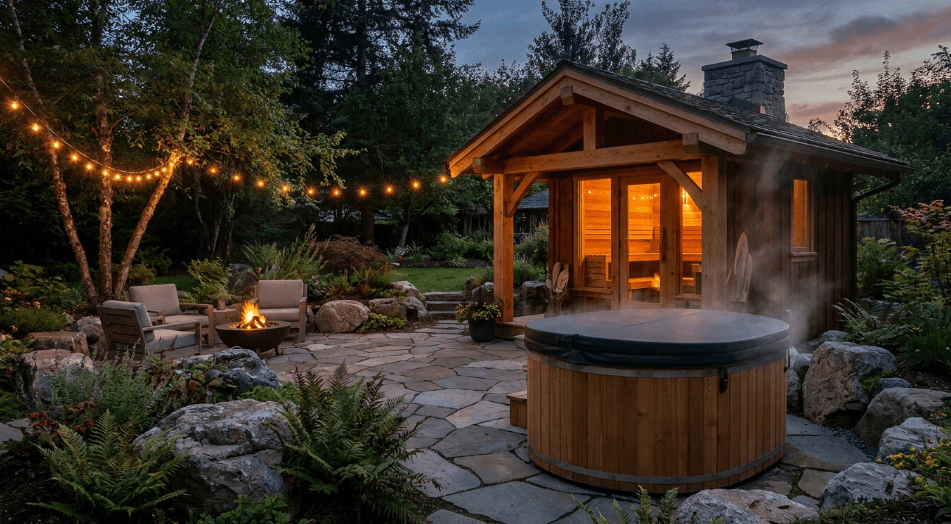
A small backyard sauna can run comfortably through a hard winter, but three things have to be right: wall insulation in the R-7 to R-11 range with a proper vapor barrier, a heater sized a step above the standard chart to account for the cold starting point, and a ventilated roof assembly that lets condensation escape instead of freezing in place. Skip any one of those and a compact cabin that worked fine in summer can develop ice buildup, slow heat-up times, or hidden rot by the following spring.
How Much Insulation Does a Cold-Climate Cabin Actually Need?
Most manufacturers spec foil-faced insulation panels in the wall cavity somewhere in the R-7 to R-11 range for a small sauna, which is thinner than typical home wall insulation but paired with a reflective foil layer that works differently, bouncing radiant heat back into the room rather than only slowing conduction. The foil layer also functions as the vapor barrier when installed on the warm interior side of the insulation, which is the detail that matters most in freezing climates. Moisture that gets past the vapor barrier and into the insulation cavity can freeze and thaw repeatedly through a winter, which degrades the insulation’s performance and can eventually damage the wall structure from the inside out.
How Big a Heater Do You Need for Freezing Temperatures?
Standard heater sizing charts size a unit in kilowatts against the cabin’s interior volume in cubic feet, typically in the range of one kW per roughly forty to fifty cubic feet for an insulated indoor cabin. An outdoor cabin exposed to freezing ambient temperatures needs to move up a step from that baseline, since the heater is fighting both the room’s volume and a colder starting surface temperature on the walls and benches. Undersizing a heater for a cold-climate installation is one of the most common regrets owners report, since it shows up as a cabin that never quite reaches full temperature on the coldest days rather than as an obvious failure.
How Do You Stop Condensation From Freezing on the Roof?
Warm, moist air escaping through the ceiling of a sauna will condense the moment it hits a cold roof deck, and in freezing weather that condensation turns to frost or ice rather than simply dripping away. A ventilated roof assembly, with a clear air gap between the top of the insulation and the underside of the roof sheathing, gives that moisture a path to vent out before it accumulates. Cabins built with a sealed, unventilated roof cavity are far more prone to ice damming and, eventually, water intrusion once the ice melts unevenly in a thaw. This is one of the more overlooked details in small cabin construction, since it does not show symptoms until the first real cold snap.
How Long Does It Take to Heat Up in Winter?
A well-insulated small cabin typically needs 40 to 60 minutes to reach full operating temperature when outdoor conditions are below freezing, compared with roughly 20 to 30 minutes on a mild day, since the heater is working against a colder starting point in the wood, the air, and the surrounding ground. Preheating on a timer or a smart plug before you plan to use it removes most of the frustration of that longer wait, and it is a habit worth building into a winter routine rather than trying to shorten with a larger heater alone.
What Else Changes About Running a Sauna in the Snow?
Snow load on the roof is worth checking against the manufacturer’s rated capacity, particularly for a flat or low-pitch roof design, since accumulated snow adds real weight that a summer-only structure might not be built to carry. Clearing a path to the door after a storm matters for the same reason a walkway to any structure does in winter, ice underfoot near a hot cabin is a genuine slip hazard. Door seals are worth checking each fall too, since a gap that was invisible in summer can let in enough cold draft to meaningfully slow heat-up on the coldest days. Anyone shopping for a cabin specifically rated for outdoor winter installation, including insulation specs and heater sizing for cold climates, can compare current listings at https://sweatdecks.com before choosing a unit for a yard that sees real snow.
Is a Cold-Climate Sauna Worth the Extra Build Detail?
For anyone in a region with a real winter, the extra attention to insulation, heater sizing, and roof ventilation is not optional add-on detail, it is the difference between a cabin that performs consistently from October through March and one that becomes a fair-weather structure by its second season. The added cost of proper cold-climate specification is usually modest relative to the total build, and it shows up in a heater that actually reaches temperature on a ten-degree evening rather than one that leaves you standing in a half-heated box.
Does Winter Change What Preheating Costs?
Preheating from a colder starting point uses more electricity than the same preheat on a mild day, simply because the heater is doing more total work to close a larger temperature gap. A session that costs roughly a dollar in electricity on a fifty degree fall evening might run closer to a dollar fifty to two dollars on a night well below freezing, once the longer preheat and the extra energy needed to hold temperature against a colder exterior wall are factored in. That difference is small in absolute terms across a single winter, typically adding up to somewhere in the range of twenty to forty extra dollars over a full cold season for someone using the cabin several times a week, but it is worth knowing about so a January electricity bill does not come as a surprise to a first-year owner.
Frequently Asked Questions
How much insulation does a cold-climate sauna need?
Most cold-climate small saunas use a foil-faced insulation layer with an R-value in roughly the R-7 to R-11 range inside the wall cavity, sealed with a vapor barrier on the warm side to keep moisture from migrating into the insulation and freezing.
Do I need a bigger heater for a sauna used in winter?
Yes, sizing typically moves up a step from the standard kW-to-cubic-foot chart when a cabin sits outside in freezing temperatures, since the heater has to overcome both the room volume and a colder starting point and colder wall surface temperature.
How do you stop condensation from freezing on a sauna roof?
A ventilated roof assembly with a clear air gap between the insulation and the roof deck lets moist air escape before it condenses and freezes, which prevents the ice buildup and eventual leaks that a sealed, unventilated roof is prone to in freezing weather.
How long does it take a small sauna to heat up in winter?
A well-insulated small cabin typically takes 40 to 60 minutes to reach full temperature in freezing outdoor conditions, roughly ten to twenty minutes longer than the same unit would take on a mild day.
References
- Effects of heat and cold on health, with special reference to Finnish sauna bathing, American Journal of Physiology – Regulatory, Integrative and Comparative Physiology, 2018.
- Cardiovascular and Other Health Benefits of Sauna Bathing: A Review of the Evidence, Mayo Clinic Proceedings, 2018.
- Benefits and risks of sauna bathing, The American Journal of Medicine, 2001.
- Underwriters Laboratories, electrical and heater safety standards reference.